

Data Centre WU Vienna
Project management, general planning, construction supervision, strategic facility management, support with EN 50600 certification
Sustainable planning – Proven
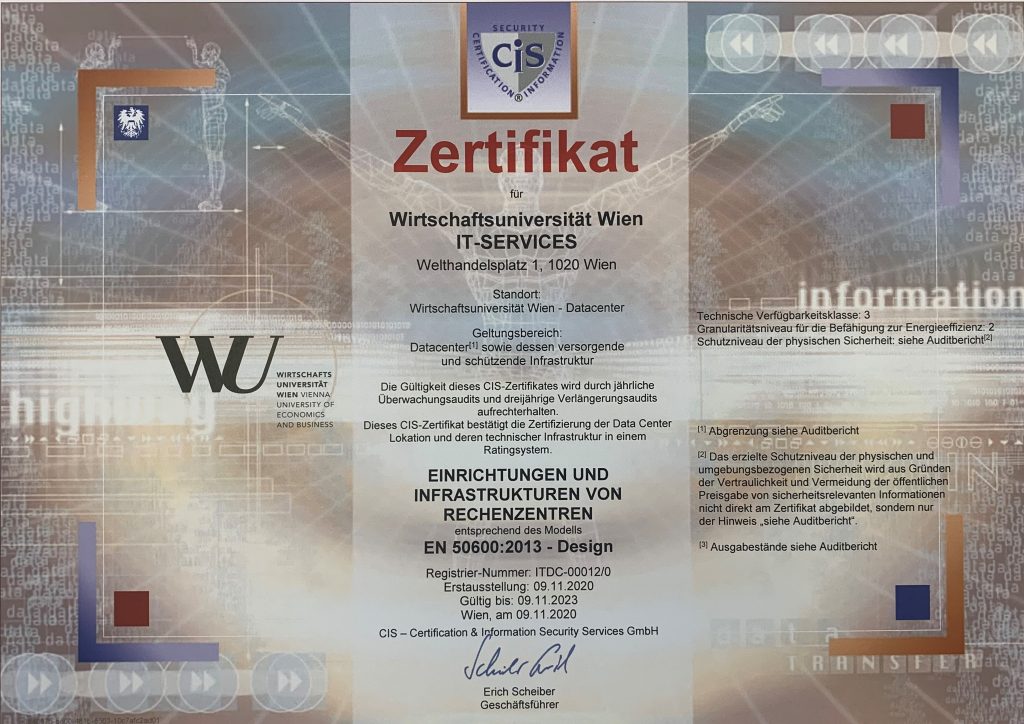
More than 10 years ago FRAUSCHER CONSULTING started planning the data centre infrastructure for the new campus of the Vienna University of Economics and Business. Four years before the first part of the EN 50600 data centre standard was published. It was the first big project for the young company. – Now, 10 years later this project has been successfully certified in availability class 3 according to EN 50600.
In 2009, ground was broken for a new, modern and sustainable campus for WU – on open land between the exhibition centre and the Prater in Vienna’s 2nd district, with good public transport connection thanks to two underground stations. Just four years later, the University of Economics finally moved from the Althanstraße University Centre (in operation since 1982) to its current home, the WU Campus.
At the site located at Welthandelsplatz 1 (named after the predecessor of WU, the University of World Trade), not only were new buildings constructed, but ideas about what a university of the future could look like were also implemented. A modern university concept was given spatial form. The campus and individual buildings have received several architectural awards, including the Schorsch-Prize from the City of Vienna, the European Award from the Royal Institute of British Architects, and the CICA Award for Urban Planning from the International Committee of Architectural Critics.
Facts & Figures
- Seven buildings form the ‘small town’ with extensive infrastructure (supermarket, restaurants, sports facilities, nursery, garages, bicycle parking, etc.).
- The site is 560 metres long and up to 210 metres wide
- Approximately 100.000 m² of net usable space, of which 55.000 m² is publicly accessible open space
- Approximately 150.000 m³ of concrete used
- Approximately 4.000 rooms (including 90 lecture halls and seminar rooms with more than 5.000 seats)
- Around 3.000 workspaces for students (1.500 in the library centre)
Two of these buildings house two symmetrical data centre complexes, each with an area of approximately 550 m². Each data centre complex has a complete primary infrastructure that supplies it and provides redundancy for the other. This creates two cores, each of which meets availability class 3 according to EN 50600 and, in some areas, even availability class 4.
A third building houses another data centre area for backup systems, and there are approximately 25 LAN distribution rooms spread across the entire campus, which are connected to the data centre cores via a fibre optic backbone using blow-in technology.
In 2013, the data centres were completed and WU’s IT systems were moved to the new location in several stages. Since then, WU Vienna’s IT has been running without a single failure on the new campus.
The planning and construction of this data centre project were completed even before the first part of the EN 50600 standard was published. Nevertheless, FRAUSCHER CONSULTING succeeded in designing the data centre infrastructure in such a way that it meets all the requirements of the current EN 50600 standard, thanks to planning based on the latest state of the art.
One of the highlights was the use of Inrow cooling units, which allow for a strict separation of cold and warm areas and thus high flow temperatures in the air conditioning cold water. This means that the data centres can be cooled very energy-efficiently in summer with well water and in winter with the ‘cold’ from the heat pumps used for heating the buildings.
The project was certified by CIS-CERT, an Austrian accredited certification body.
In order to continuously monitor and improve energy efficiency during ongoing operations, FRAUSCHER CONSULTING assisted WU Vienna with the implementation of the European Code of Conduct on Data Centres back in 2015 and conducts annual audits to optimise and monitor energy consumption.
Since 2015, Gernot Frauscher has been a member of the European working group TC215/WG3 of CENELEC, which develops the EN 50600 series of standards. Since 2017, he has been editor of EN 50600-2-3. Much of the practical experience gained from the WU Vienna project has also been incorporated into the EN 50600 standard and subsequently into ISO 22237. Gernot Frauscher is project leader for the ISO/IEC 22237-4 and ISO/IEC 22237-6 parts of the standard. FRAUSCHER CONULTING’s active participation in international standardisation projects thus creates a valuable feedback loop that benefits our customers and all users of the standards.